Key Takeaways
- Choose squash court wooden flooring designed specifically for high-impact play to enhance performance and stability.
- Evaluate grip first, as it is essential for quick movements and maintaining control on the court.
- Look for effective shock absorption in flooring to protect players during intense matches and reduce injury risk.
- Ensure the chosen flooring can withstand intensive play and is suitable for regular use in sports facilities.
- Consider consistent ball bounce and proper installation to achieve reliable and even playing conditions.
Sundek Sports Private Limited, a leading manufacturer of squash court flooring, provides performance-focused flooring systems for professional tournaments, sports academies, clubs, universities, fitness centres and recreational facilities.
Squash involves rapid acceleration, sudden stops, lunges and repeated impact, so the floor has to support both movement and stability. Choosing the right squash court wooden flooring means looking beyond appearance and considering grip, shock absorption, durability, ball response and installation quality.
Start With Flooring Designed Specifically for Squash
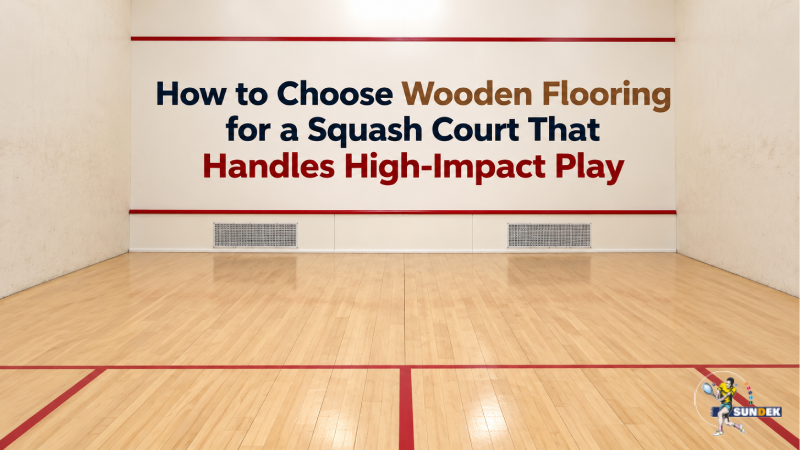
A standard wooden floor and a sports-grade squash floor serve very different purposes. Squash courts experience concentrated foot pressure, fast lateral movement and continuous player impact during rallies. The surface therefore needs to provide a reliable combination of resilience and traction.
At Sundek Sports Private Limited, we use high-grade wooden flooring as one of our primary squash court solutions. Our website also states that our squash flooring systems are designed for excellent grip, shock absorption and durability, with flooring approved by the World Squash Federation for professional and recreational use.
The right squash floor should perform as part of the game, not simply cover the subfloor.
Check the Grip Before Anything Else
Grip is one of the first performance factors to evaluate in squash court wooden flooring. Players need to change direction quickly, move into corners and recover position without losing control underfoot.
A surface that is too slippery can affect stability, while an unsuitable finish can interfere with confident movement. Sundek’s squash flooring is positioned around a smooth yet slip-resistant playing surface that supports fast-paced matches.
Before choosing a flooring option, make sure it is specifically designed for indoor racquet sports instead of standard architectural flooring.The surface should allow quick footwork while maintaining dependable traction throughout the playing area.
Look for Effective Shock Absorption
Squash is a high-impact sport because players repeatedly lunge, push off and stop sharply throughout a match. A rigid floor can transfer more of this force directly back through the body.
Wooden sports flooring is widely used for squash because hardwood provides natural resilience, while a properly built flooring system can support impact reduction and player comfort. Sundek highlights shock absorption as one of the key performance characteristics of its squash court flooring.
For B2B buyers, this makes the flooring structure just as important as the visible surface. Impact response should be evaluated as part of the complete flooring system, not only by the type of wood used.
Choose a Floor That Can Handle Intensive Play
Durability matters for courts used in academies, clubs, universities and sports centres where playing hours may be high. The flooring should be able to handle repeated foot traffic, movement and daily sports activity without quickly losing its performance characteristics.
The main factors buyers should review include:
- Quality of the wooden flooring material
- Suitability for repeated indoor sports use
- Resistance to wear under heavy play
- Ease of routine cleaning and maintenance
- Professional installation and subfloor preparation
- Compatibility with the overall squash court construction
These points help buyers assess whether the floor is suitable for a serious sports facility rather than occasional recreational use.
Consistent Ball Bounce Also Matters
Although player movement is the main concern when choosing squash court wooden flooring, ball response should not be ignored. The floor is part of the playing environment, and unevenness or poor installation can affect the consistency of the court.
Sundek’s squash flooring page highlights consistent ball bounce as one of the benefits of a properly constructed squash floor. It also states that court construction involves precise levelling, moisture control and seamless installation.
This means flooring selection and installation cannot be treated as separate decisions. A good material installed on an unsuitable or uneven base may not deliver the required playing characteristics.
Evaluate Installation as Carefully as the Material
The best flooring material still depends on correct site preparation and professional installation. For squash courts, this begins with site analysis and assessment of the space before the flooring system is selected.
At Sundek Sports Private Limited, our process includes site analysis, flooring selection, design, installation and after-sales support. We also provide complete squash court solutions that can include wooden flooring, glass back walls, hard plaster, LED lighting and vinyl flooring, depending on project requirements.
Before finalising a supplier, check:
- Whether site assessment is included
- Whether subfloor levelling is addressed
- Whether moisture conditions are reviewed
- Whether the flooring is designed for squash
- Whether professional installation is available
- Whether post-installation support is provided
A reliable installation process helps the flooring perform as intended under continuous high-impact play.
Match the Flooring to Your Facility Type
Not every squash facility has the same usage pattern. A professional training academy may have different requirements from a private residential court or corporate recreational facility.
Squash court wooden flooring is widely used in professional tournaments, sports clubs, training academies, universities, fitness centres, private clubs, and recreational facilities. Hardwood flooring provides a reliable combination of durability, grip, re
The final flooring choice should therefore consider expected usage intensity, the type of players using the court, maintenance needs and the overall court design.
Why Choose Us
At Sundek Sports Private Limited, we provide end-to-end squash court flooring and construction solutions backed by our experience in sports infrastructure. Our squash flooring systems are developed around grip, shock absorption, durability and consistent playing performance. We support clients from site analysis and flooring selection through installation and after-sales service, helping sports academies, universities, clubs, complexes and recreational facilities develop courts suited to their specific usage requirements.
Conclusion
Choosing the right squash court wooden flooring requires more than selecting an attractive hardwood surface. Buyers should look at traction, impact reduction, durability, ball response, subfloor preparation and installation quality as part of one complete system. A flooring solution developed specifically for squash can support rapid movement, intensive daily use and a more consistent playing environment. At Sundek Sports Private Limited, we provide wooden squash flooring and complete court solutions designed around the practical demands of high-impact indoor play.
Planning a new squash court or upgrading an existing facility? Speak with our team about professional squash court wooden flooring and complete squash court construction solutions for sports academies, clubs, universities, fitness centres and private facilities.
Call: +91 98980 88059
Email: info@sundek.in
Frequently Asked Questions
What is the best type of wooden flooring for a squash court?
The best wooden flooring for a squash court is specifically designed for sports use, providing optimal grip, shock absorption, and durability. Look for flooring systems that are approved by the World Squash Federation to ensure they meet professional standards.
How important is shock absorption in squash court wooden flooring?
Shock absorption is crucial in squash court wooden flooring since players frequently lunge and stop abruptly. A floor with effective shock absorption helps reduce the impact on players’ bodies, enhancing comfort and performance throughout matches.
What factors should I consider when choosing squash court wooden flooring?
When choosing squash court wooden flooring, consider grip, shock absorption, durability, ball response, and the quality of installation. It’s essential that the flooring is designed specifically for squash to withstand the high-impact nature of the sport.
Can I use standard wooden flooring for a squash court?
No, standard wooden flooring is not suitable for a squash court due to its inability to provide the necessary grip and shock absorption. It’s important to choose flooring designed specifically for squash to ensure player safety and optimal performance.
What maintenance is required for squash court wooden flooring?
Maintenance for squash court wooden flooring typically includes routine cleaning to remove dust and debris, as well as periodic inspections for wear and tear. Proper care helps maintain the flooring’s performance characteristics and extends its lifespan.